How To Search for Montgomery Property Records

You should always review property records before buying or investing in real estate. These records are a goldmine of information that can reveal crucial details for due diligence, including ownership history, assessed values, tax information, property boundaries, zoning classifications, building characteristics, amenities, permitted uses, liens, and foreclosures. Property records are public in Montgomery, meaning that they can generally be viewed or copied by anyone interested in doing so. The key is knowing where to look. We have provided a list of useful resources for finding different types of Montgomery property records below.
Montgomery County Probate Court

The Montgomery County Probate Court records and maintains copies of deeds, mortgages, liens, deeds of trust, plats, contracts, lis pendens, and other official documents that establish property ownership and interests within the City of Montgomery (and the rest of the county). The court provides a Probate Records Search tool that you can use to access these documents online. Searches can be done by name, instrument number, date range, and several other criteria. While index searches are free, fees apply for viewing images and downloading copies, with the option of paying per search or registering an account for frequent users. You may also contact the court's Records & Recording Division at Courthouse Annex III, 101 South Lawrence Street, Montgomery, AL 36101 to search and copy records in person or call the records service desk at (334) 832-1239 for inquiries and general assistance.
Montgomery County Revenue Commissioner's Office
The Montgomery County Revenue Commissioner's Office is responsible for identifying, listing, and valuing property in Montgomery for tax purposes, as well as handling property tax billing, collection, and distribution. This office is a primary resource for property information in the city, ranging from ownership details, valuation data, recent sales history, and building characteristics to current and prior tax bills, delinquency status, payment histories, and much more. You can search this information on the office's website by name, parcel number, address, or key number. For in-person services, you can visit the office at 101 S. Lawrence St., Montgomery, AL 36104. You may also call (334) 832-1250 for general inquiries and assistance.
Fifteenth Judicial Circuit Court of Alabama

You can obtain records of foreclosure filings, civil judgments, partition actions, code enforcement matters, and other disputes that affect property use in Montgomery through the Fifteenth Judicial Circuit Court of Alabama. These records can be accessed online via the Alabama Judicial System's Alacourt Access portal (note: this is a subscription-based service with options for one-time searches or ongoing case monitoring). You can also visit the Montgomery County Courthouse at the Phelps-Price Justice Center, 251 S Lawrence St., Montgomery, AL 36104, to search and copy records in person. Note that copy fees may apply. You may call the court at (334) 832-1260 for general inquiries and assistance.
City of Montgomery GIS Resources

The City of Montgomery provides a GIS Viewer on its website that you can use to explore property and geographic data. Searches are primarily done by address, with options to layer additional results. Through the viewer, you can access property details (acreage, square footage, lot/block, ownership, etc.), as well as overlays for flood zones, utilities, aerial imagery, and maps. The tool also allows you to verify zoning districts, land use classifications, and economic/tax incentive zones, making it a valuable resource for property research and planning.
Montgomery Property Taxes
Montgomery property taxes are a crucial source of funding for essential local government services, such as public schools, police and fire departments, emergency response, road maintenance, county health systems and hospitals, and more. The Montgomery County Revenue Commissioner's Office determines the taxable value of all real property in the city and is also responsible for billing, collecting, and distributing property taxes.
A property's tax bill is determined through a three-step process: valuation, calculation, and adjustment. The revenue commissioner's office begins by identifying the property, classifying it, and estimating its fair market value. That value is then multiplied by a state-mandated assessment ratio (based on classification) to determine its assessed value. Once this is done, appropriate local millage rates are applied to the assessed value, and any applicable exemptions are deducted to arrive at the final tax bill. Properties are assessed annually to reflect current market conditions. However, annual increases in the assessed values of certain types of properties, such as owner-occupied residential and commercial properties, are capped at 7%, preventing sharp spikes in property taxes even during market shifts.
Property taxes are due on October 1st each year. While courtesy tax notices are typically mailed before this date, it is important to note that Alabama law does not require them, and property owners are solely responsible for paying their taxes on time, regardless of whether a notice was received. Payments may be made without penalty until December 31st. Taxes become delinquent on January 1st and begin accruing interest immediately. A delinquent and final tax bill is usually sent around February. If taxes remain unpaid after this, the property may become subject to tax lien sales to recover the owed amount. There are several options for paying Montgomery property taxes, including online, mail-in, and in-person transactions. You can call (334) 832-1250 for additional information and general assistance.
![]() Assessments
Assessments

The Montgomery County Revenue Commissioner's Office assesses properties in the City of Montgomery every year to establish each property's taxable value. Each property is identified, classified as either a Class I (utilities), Class II (commercial, rental, industrial, and other non-homestead), or Class III (agricultural, forest, and owner-occupied residential) property, and then valued. Valuations are done using standard mass appraisal methods, including the sales comparison approach (analyzing recent sales of similar properties), the cost approach (land value plus construction cost minus depreciation), and the income approach (estimating value based on income-producing potential).
Once a property's fair market value is determined, that value is multiplied by a state-mandated assessment percentage (based on its classification) to calculate its assessed value. This assessed value is then adjusted by applying local millage rates, minus applicable exemptions, to determine the final tax bill. Per state law, the assessed value of a Class II or Class III property cannot increase by more than 7% with each annual assessment, except in situations where there is a change in property ownership or significant improvements to the property.
Valuation notices are usually sent out in late spring or early summer, informing property owners of the assessed value that would be used to calculate the upcoming year's taxes, along with any changes from the previous year. If you disagree with your valuation, you can file an appeal with the Montgomery County Board of Equalization (BOE). Appeals must be submitted within 30 days of receiving the valuation notice. You can call the revenue commissioner's office at (334) 832-1250 for additional information or assistance with the process.
![]() Appraisals
Appraisals

Montgomery assessments work similarly to appraisals. They both determine the fair value of property by comparing similar properties with others in the local area that have sold recently. In cases of odd structures or new construction, the county may call upon an appraiser to help determine the value. Estate planners, courts, and lenders also use appraisals to value real property.
![]() Tax Rates
Tax Rates

Montgomery, Alabama, has a median effective property tax rate of 0.48%, below the national median of 1.02% and slightly above the Alabama state median of 0.47%. The average annual tax bill in the city is $748, which is also significantly below the national average of $2,400.
Here's a look at how Montgomery's property tax rates compare to other counties in Alabama:
- Autauga County 0.29%
- Baldwin County 0.33%
- Calhoun County 0.44%
- Chambers County 0.43%
- Etowah County 0.42%
- Houston County 0.36%
- Jefferson County 0.71%
- Lee County 0.52%
- Madison County 0.56%
- Mobile County 0.59%
- Perry County 0.45%
- Pike County 0.35%
- Russell County 0.55%
- Sumter County 0.37%
- Tuscaloosa County 0.46%
- Walker County 0.31%
![]() Exemptions
Exemptions

While Montgomery's property tax rates are typical for the region and generally well below the national average, some homeowners may still find it difficult to meet their tax obligations. Thankfully, there are several property tax exemptions available to eligible residents to help reduce their overall tax burden. Common exemptions include:
-
General Homestead Exemption: Exempts up to $6,000 from a property's assessed value (up to $4,000 for state taxes and $2,000 for county taxes) for residents who own and occupy the property as their primary residence.
-
Senior Exemptions: Provides partial or full exemptions (depending on annual income) for homeowners aged 65+.
-
Disability Exemptions: Provides exemptions for homeowners who are permanently and totally disabled, regardless of their age or annual income.
-
Veterans Exemptions: Available to veterans with qualifying service-connected disabilities.
You can contact the Montgomery County Revenue Commissioner's Office at (334) 832-1250 for additional information or assistance with applying for available tax exemptions.
Montgomery Building Permits/Inspections
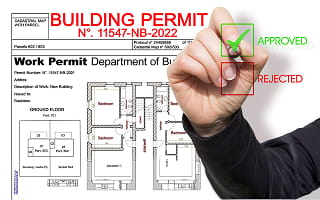
You need a permit for most construction, renovation, and home improvement projects in Montgomery. Exemptions are usually made for cosmetic work like painting, wallpapering, and cabinet installations, as well as for certain other minor or general repairs and improvements, as long as the work does not affect a building's structure or core systems. Permits are issued by the Montgomery Inspections Department. You can apply for one, schedule inspections, and make necessary payments through the department's website. In-person services are also available at the department's office, located at 25 Washington Ave., Montgomery, AL 36104, and you can call (334) 625-2073 for general inquiries and assistance.
Common types of permits issued in Montgomery include:
-
Building Permits: For constructing, altering, repairing, demolishing, or changing the occupancy of a building or structure.
-
Electrical Permits: For installing, altering, or repairing electrical wiring, systems, or equipment.
-
Gas Permits: For installing, altering, or repairing fuel gas piping systems, appliances, or equipment.
-
Mechanical Permits: For installing, altering, or repairing heating, ventilation, air conditioning (HVAC), and other mechanical systems.
-
Plumbing Permits: For installing, altering, or repairing water supply, drainage, and other plumbing systems.
When applying for any of these permits, you must submit the proper documentation (building plans, blueprints, contractor licenses, materials lists, etc.). You must also pay the appropriate fee.
Building inspections are part of the permit process, and they ensure that the work complies with local building and safety codes. You can schedule an inspection through the online portal or in person at the office during regular business hours.
Real Estate in the City of Montgomery

Deeply rooted in American history, Montgomery is the capital city of Alabama and serves as a central hub for state government and culture. Originally the first capital of the Confederacy, the city later became a major center of the Civil Rights Movement, playing a pivotal role in landmark events like the Montgomery Bus Boycott and the Selma to Montgomery marches. Montgomery is home to several historic and cultural landmarks, including the Rosa Parks Museum, the Dexter Avenue King Memorial Baptist Church, and the National Memorial for Peace and Justice. Its central location in the state's Black Belt region, the presence of Maxwell Air Force Base, a growing automotive manufacturing sector, and attractions like the Alabama Shakespeare Festival, the Montgomery Museum of Fine Arts, and the Riverwalk Stadium also contribute to a strong and diverse local economy.
Montgomery, Alabama, has a population of 200,603 residents. The city has 95,296 housing units, with about 87% occupied and 55% owner-occupied. There is a wide range of housing options available, including single-family homes, townhomes, apartments, condos, historic homes, and suburban development, with common housing styles like Ranch, Victorian, Antebellum, Craftsman, and Colonial Revival. The average home value in Montgomery, AL, is $145,280, representing a 0.2% increase from previous years. Note that actual values can vary significantly depending on the neighborhood. Here are some examples of average home prices in different Montgomery neighborhoods:
- Cloverdale-Idlewild $240,000
- Capitol Heights $160,000
- Dalraida $180,000
- East Montgomery $280,000
- Garden District $175,000
- Old Cloverdale $245,000
- McGehee Estates $350,000
The Montgomery, Alabama, real estate market is a moderately competitive, buyer-leaning market. Homes typically go under contract within about 45 days of listing, and approximately 15% of listed properties sell above their initial asking price.
Searching across multiple government offices and databases to piece together a complete property profile can be time-consuming, but PropertyChecker simplifies the process by pulling key ownership details, tax records, transaction histories, and more into a single, easy-to-use platform. Whether you are buying, investing, or simply doing your due diligence, visit PropertyChecker.com to get the property information you need in minutes.